Intake has always been the slowest part of running a concierge cellar. Each bottle needs to be identified, recorded with its producer, wine, vintage, size and condition, assigned to a location and often given a value. For a new member with several hundred bottles, that can mean days of careful typing, and every typed detail is a chance for a small error.
Artificial intelligence is now genuinely useful here. It can read a label from a photograph, suggest the details a person would otherwise look up and offer a reference value in seconds. But it has real limits, and the operators getting the most from it are the ones who understand exactly where those limits are.
What AI does well
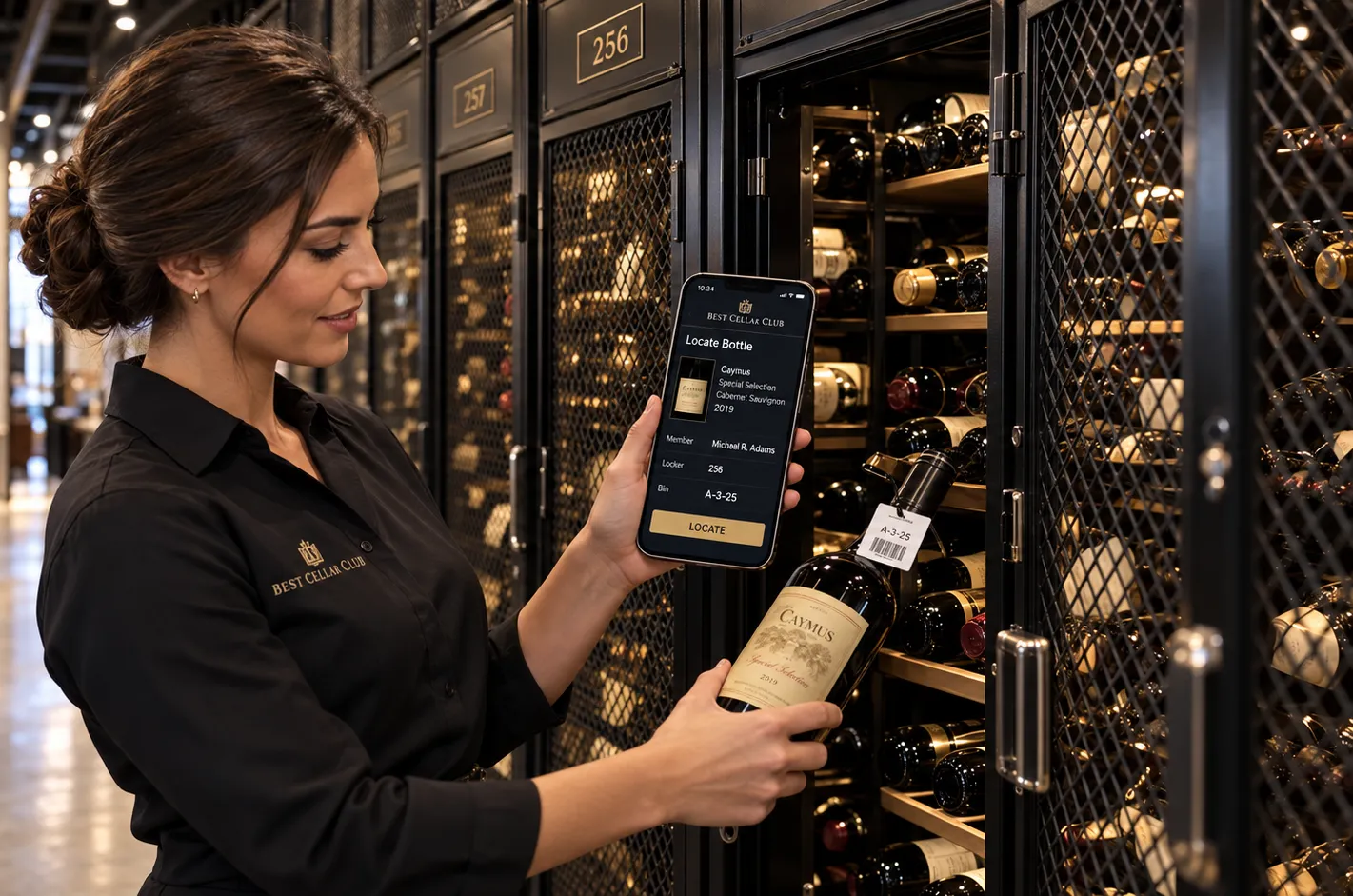
The most immediately helpful task is reading labels. A clear photograph of a bottle is usually enough for AI to identify the producer, the wine, the vintage and often the region and bottle size. For a staff member facing a table of bottles, photographing each label and confirming the result is far faster than typing everything from scratch.
AI is also good at filling in the details a person would otherwise research: the region, the grape, the appellation and a reasonable drinking window based on the style and vintage. Those details used to be left blank because nobody had time to look them up. Now they can be filled in routinely, which makes every member’s records richer and far more useful.
Reference values, with honesty about uncertainty
AI can also research current market pricing and suggest a reference value for a bottle. This is valuable for insurance summaries and for giving members a sense of what their collection is worth. The best tools present these values with a range and an indication of confidence rather than a single precise number, because fine wine prices vary with condition, provenance and the market.
Treat these values as references, not appraisals. They are useful for most everyday purposes, but they are not a substitute for a formal appraisal when one is needed for insurance or legal reasons. Be clear with members about which is which.
What AI can’t do
Some of the most important judgments at intake still require an experienced person. AI reading a label cannot assess the fill level, which is a key indicator of how a bottle has been stored. It cannot judge the condition of the cork or capsule, spot seepage or notice a label that has been damaged by damp. These details affect value and drinking quality, and they need human eyes.
AI can also be confused by the subtleties that matter most to collectors. It may not reliably distinguish between closely related bottlings, a producer’s first and second wines, different cuvées with similar labels, or unusual formats. It knows nothing about a bottle’s provenance or history. A careful person must confirm these details, especially for valuable bottles.
The right workflow: suggest, check, confirm
The most reliable approach treats AI as an assistant that drafts and a person as the one who decides. A staff member photographs the label, the system suggests the details, and the staff member checks them against the bottle before anything is saved. Condition is always assessed and recorded by the person.
Look for tools that make this checking easy. Suggestions should appear in the normal entry form where they can be corrected, not saved automatically. The system should show how confident it is, so staff know which suggestions need a closer look. And every record should show which staff member entered it, so responsibility stays clear.
Speeding up the rest of intake
Reading labels is only part of what makes intake slow. Much of the time is spent on repetitive steps around each bottle. When a member drops off a case of twelve different bottles all going into the same bin, re-selecting the member and the bin for every single bottle wastes time and invites mistakes.
Good intake software reduces this repetition. Batch entry that keeps the member, bin, bottle size and condition fixed while you add each new wine can cut a delivery’s entry time dramatically. Finding a bin by typing part of its address, rather than scrolling through thousands of options, saves more. A running count of how full the chosen bin is, updated as each bottle is added, stops staff overfilling it.
Accuracy is the whole point
It is tempting to measure AI purely by the time it saves, but the greater benefit is often accuracy. Typing produces errors: a wrong vintage, a misspelled producer, a bottle assigned to the wrong member. Photograph-based entry, checked by a person, tends to produce cleaner records than manual typing alone.
Clean records matter enormously in this business. They are what allow a member to trust the list on their phone, an insurer to rely on a schedule and a staff member to find a bottle instantly. Any tool that improves accuracy at intake improves every part of the service that depends on it afterwards.
Large formats, mixed cases and older bottles
Some bottles need extra care at intake whatever tools you use. Large formats such as magnums and double magnums should have their size confirmed by a person, since a photograph alone can mislead and the size affects both storage and value. Mixed cases need each bottle identified individually rather than assumed to match the label on the box.
Older bottles deserve the most attention. Labels may be faded, damaged or missing, and AI reading a partial label may guess with more confidence than the evidence supports. Treat any suggestion as a starting point, check the capsule, the cork and any markings on the glass, and record exactly what you can see. When in doubt, note the uncertainty in the record rather than filling the gap with a plausible guess.
A practical intake day
Here is how a well-run intake of a new member’s collection might go. Bottles are unpacked in batches by bin. For each batch, the staff member selects the member and the bin once, then photographs each label in turn. The system suggests the details, the staff member checks each suggestion against the bottle, records condition and saves it before moving on. Reference values are researched and reviewed before anything is shared with the member.
By the end of the day, the member’s whole collection appears in their portal, each bottle in its bin with its details and drinking window. The staff member has spent the day looking at wine rather than typing, and the records are cleaner than a day of manual entry would have produced.
A day like that also gives the member something valuable: a complete, accurate list of their collection, often for the first time. Many collectors have never had one. Sending it at the end of intake, with a note about anything unusual you found, is one of the best first impressions a storage business can make.
Introducing AI to your team
Staff sometimes worry that AI will replace their expertise. In practice, it removes the tedious parts of the job and leaves the parts that need knowledge and judgment. Present it that way. An experienced cellar hand checking AI suggestions and assessing condition is doing more valuable work than one typing producer names all day.
Start with a trial on a real delivery, compare the time and accuracy with your usual method and gather feedback from the team. Most operators find that once staff experience the speed of photograph-based entry, they don’t want to go back. The expertise that makes your service trustworthy remains exactly where it belongs, in the hands of your people.
Built for this. In Best Cellar Club, staff photograph a label and the details fill in with a confidence level, estimated values come with a range and a rationale, and nothing is saved until a person reviews it. Batch entry keeps the member and bin pinned for a whole delivery. Take the 2-minute tour →